For operators
Register on the system. Compile your data.
Use it to apply for services.
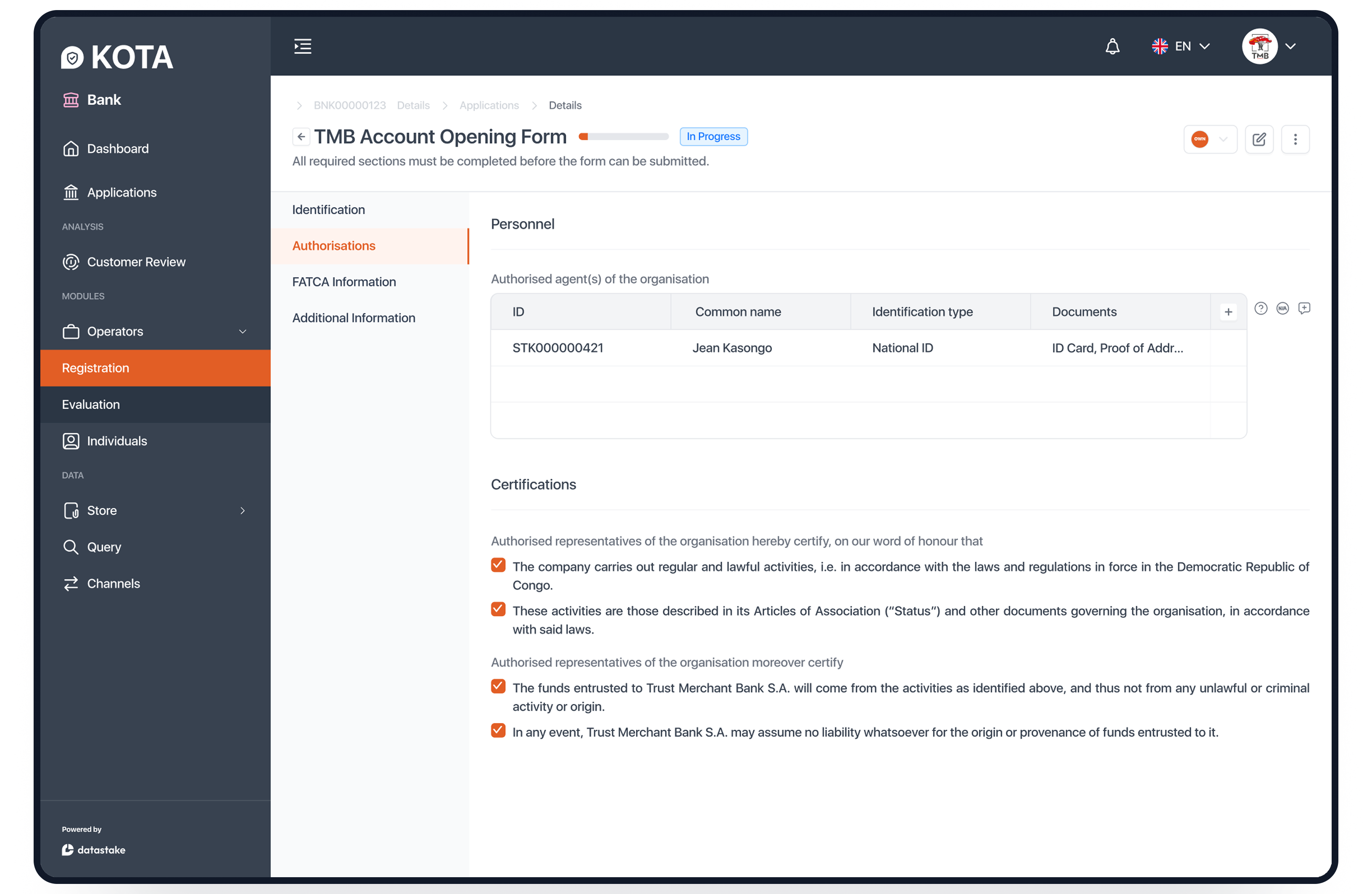
You aren't filling out one bank's form for one-time use. KOTA guides you to take the information you already have (registration, sites, operations, people, trade) and organise it into a structured digital identity.
That same identity then becomes your foundation for opening a bank account, applying for credit, engaging a buyer or proving your status to a government office. You decide who sees what, and for how long.

South Kivu · DRC
A work that earns attention.
How it works
Four steps. You set the pace.
From registration to your first decision and beyond. Each step builds the profile every later counterparty will also read.
- 1RegisterCreate an organisation on KOTA in minutes. No gatekeeping, no scheme to enroll in.
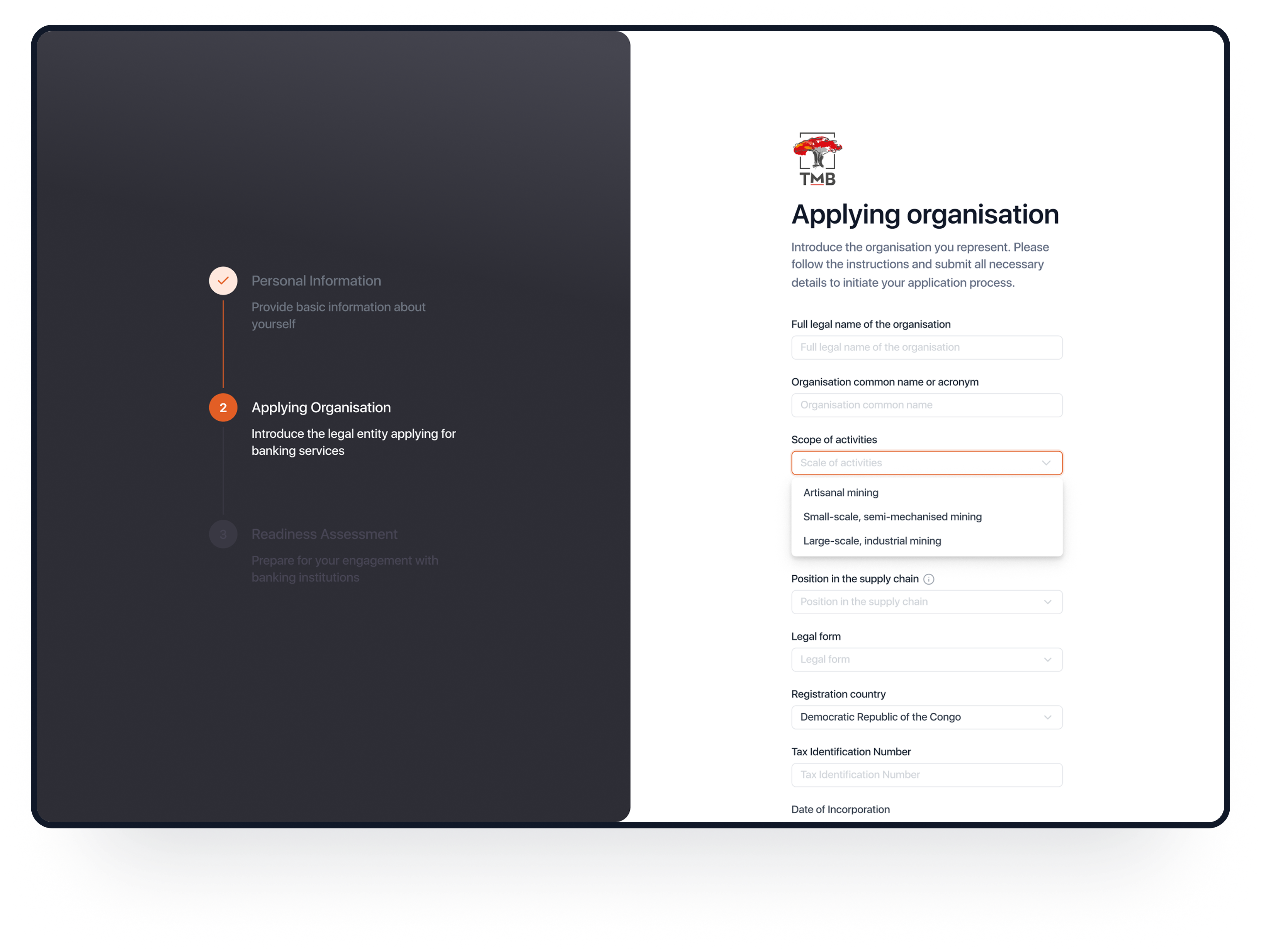
- 2Compile your profileWalk through what banks and counterparties need, field by field. At your own pace, with guidance, and a meter that shows what's left.
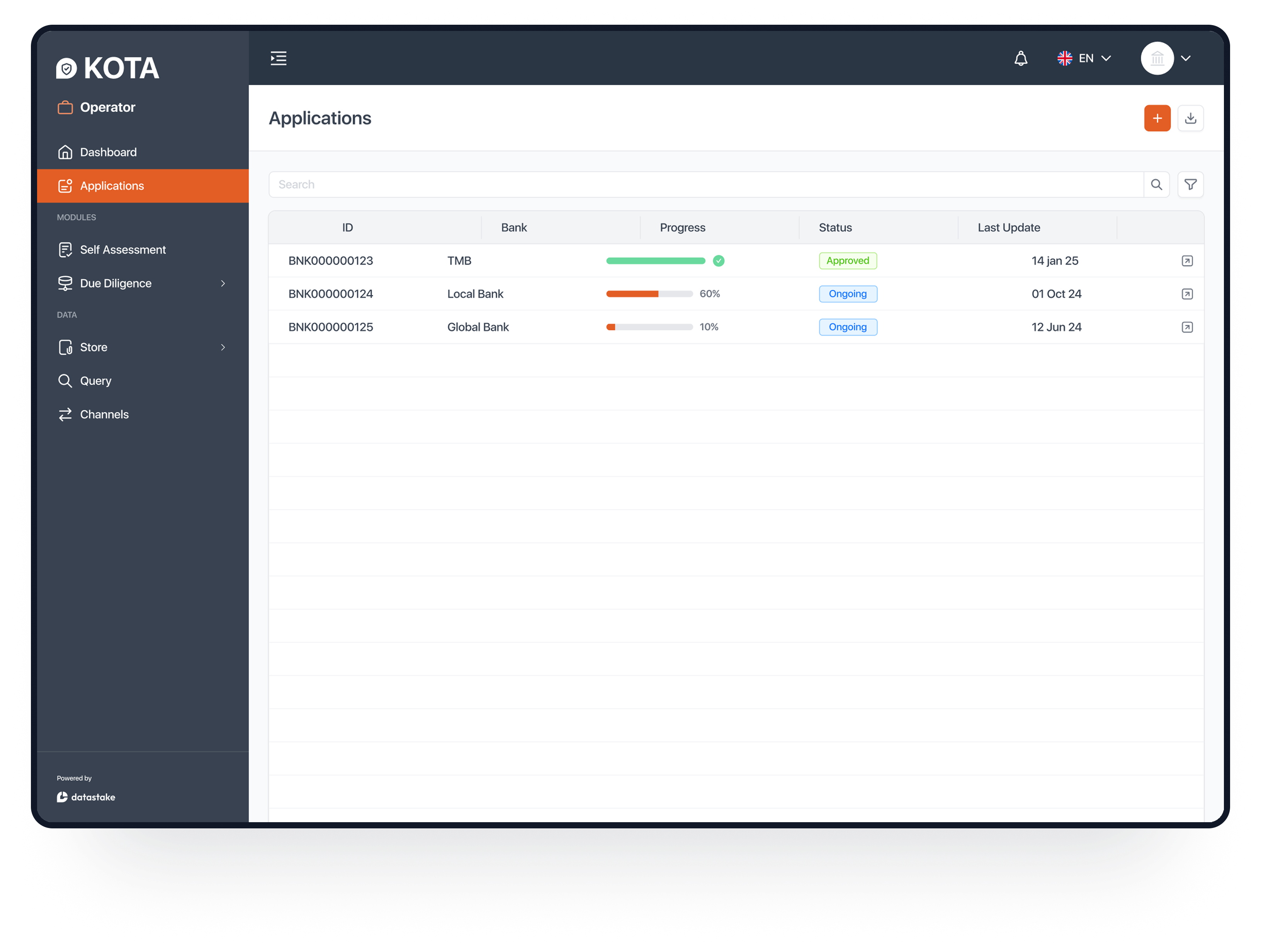
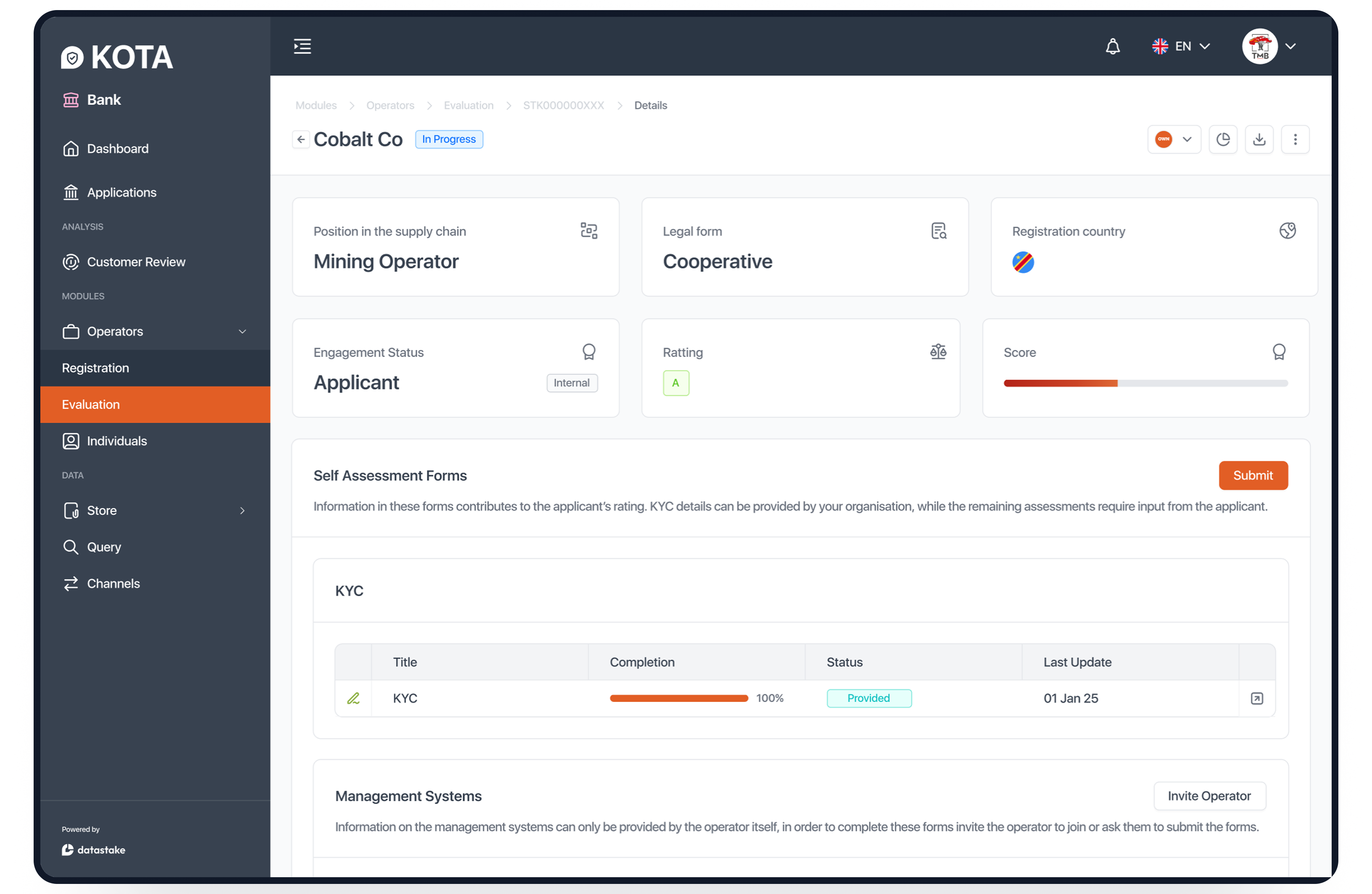
- 3Apply to a bankShare the scopes the bank needs. Track the review. Receive a decision and guidance, anchored in your record.
- 4Reuse for the next counterpartyThe same profile applies to the next bank, the next buyer, the next regulator. Each engagement reuses what you've already compiled — no duplication of effort across the chain.
01
COMPILE
Guided compilation
Build your profile step by step. In your own time.
KOTA is not a blank form. It walks you through what to enter, field by field. Save your progress and come back when the next document is in hand.
At every step, the platform makes clear what is still missing and why each piece matters. The result is a profile that is complete in context, defensible under review, and ready to engage the market: to apply to a bank, or to your partners.
Five modules. One overall readiness score.Each module (identity, sites, operations, people, trade) tracks how complete it is on its own ring. The bar at the top combines them into a single Profile Ready score (72% in this example), which climbs as you fill more in.
Plain language
Each field is explained in terms of your actual work, not a legal manual.
No deadline
Save your progress. Return when the next document is in hand.
Always-on guide
A readiness meter shows what's left and why each piece matters.
02
STORE + REUSE
Your record, held by you
Compile once. Reuse for the next bank, the next buyer, the next shipment.
You already gather many documents, declarations and forms to respond to banks, buyers, government offices and certifiers, usually one process at a time and each with its own template. KOTA brings all of that together into one record that stays with you. When a new request comes in, you respond by sharing only the parts that apply.
Your records remain yours. Your structured information is yours to keep, to update, and to reuse, so you never have to start over with the next counterparty.
One record, held by you. Reused for every counterparty.Your transparency efforts naturally compound over time.
You decide what is shared
Pick what each counterparty sees. Update it later. Revoke when needed.
No shared database
There is no master vault that anyone else reads from. Your data belongs to you.
Yours to keep
Stop using KOTA, and your record stays with you. Portable, by structure.
03
COMPLY
Compliant on your own terms
Comply with the OECD Due Diligence Guidance. Without enrolling in a foreign programme.
The OECD's five steps of due diligence are already the shape of your KOTA reporting system. As you compile, you're doing the work the international standard asks for, and you can demonstrate that anywhere.
And it's free, because it also helps banks navigate the local context and lower their risk.
You comply by compiling and sharing.The OECD Due Diligence five steps are already the shape of the KOTA reporting system. Each step you complete is a step toward the international standard, with no foreign programme to depend on.
Standard, built in
The OECD five-step structure is the shape of the profile, not an extra module.
No enrollment
No traceability scheme to subscribe to. No third party to clear you through.
No lock-in
Your profile is portable. You aren't tied to a programme that controls your data.
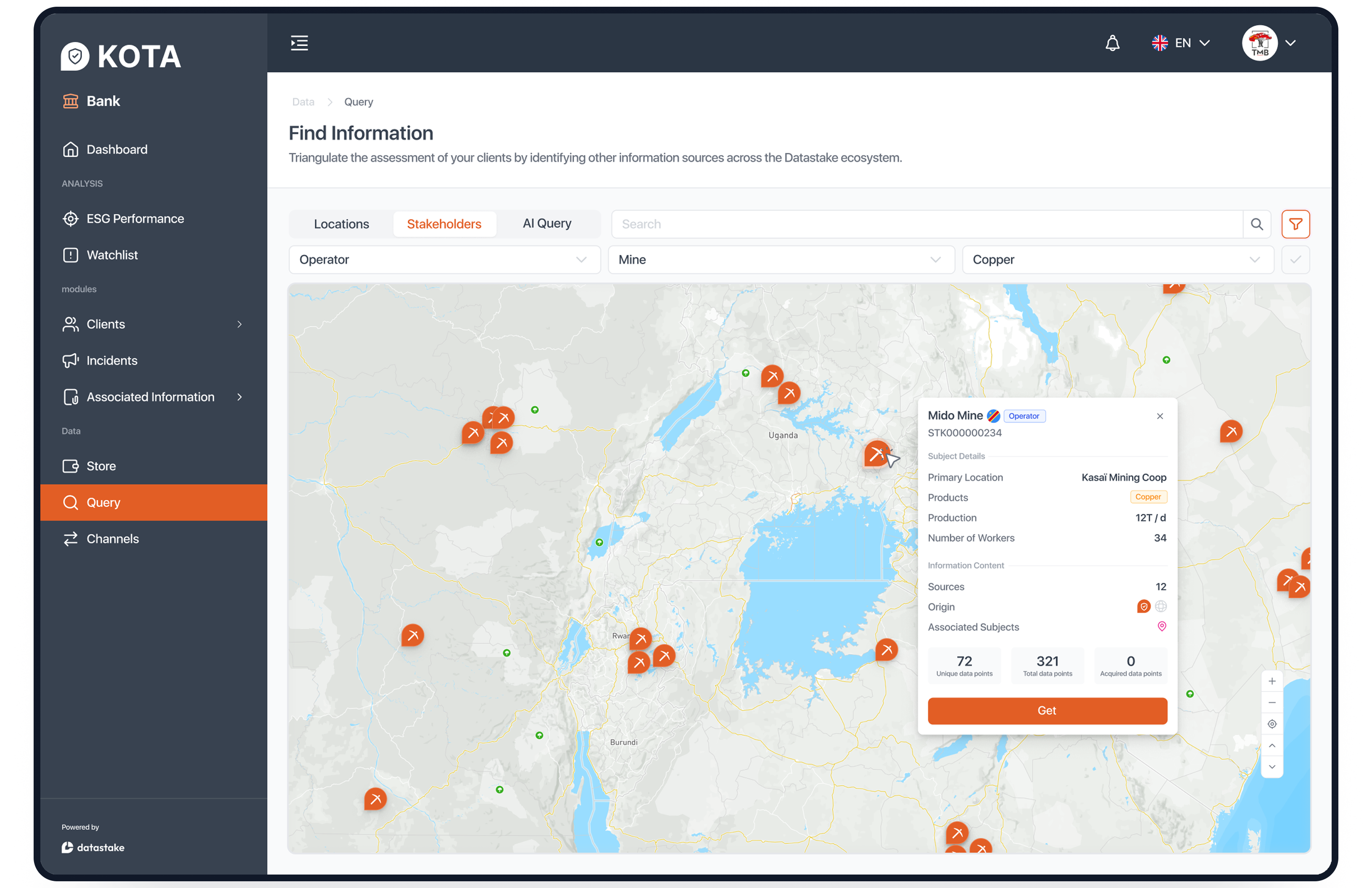
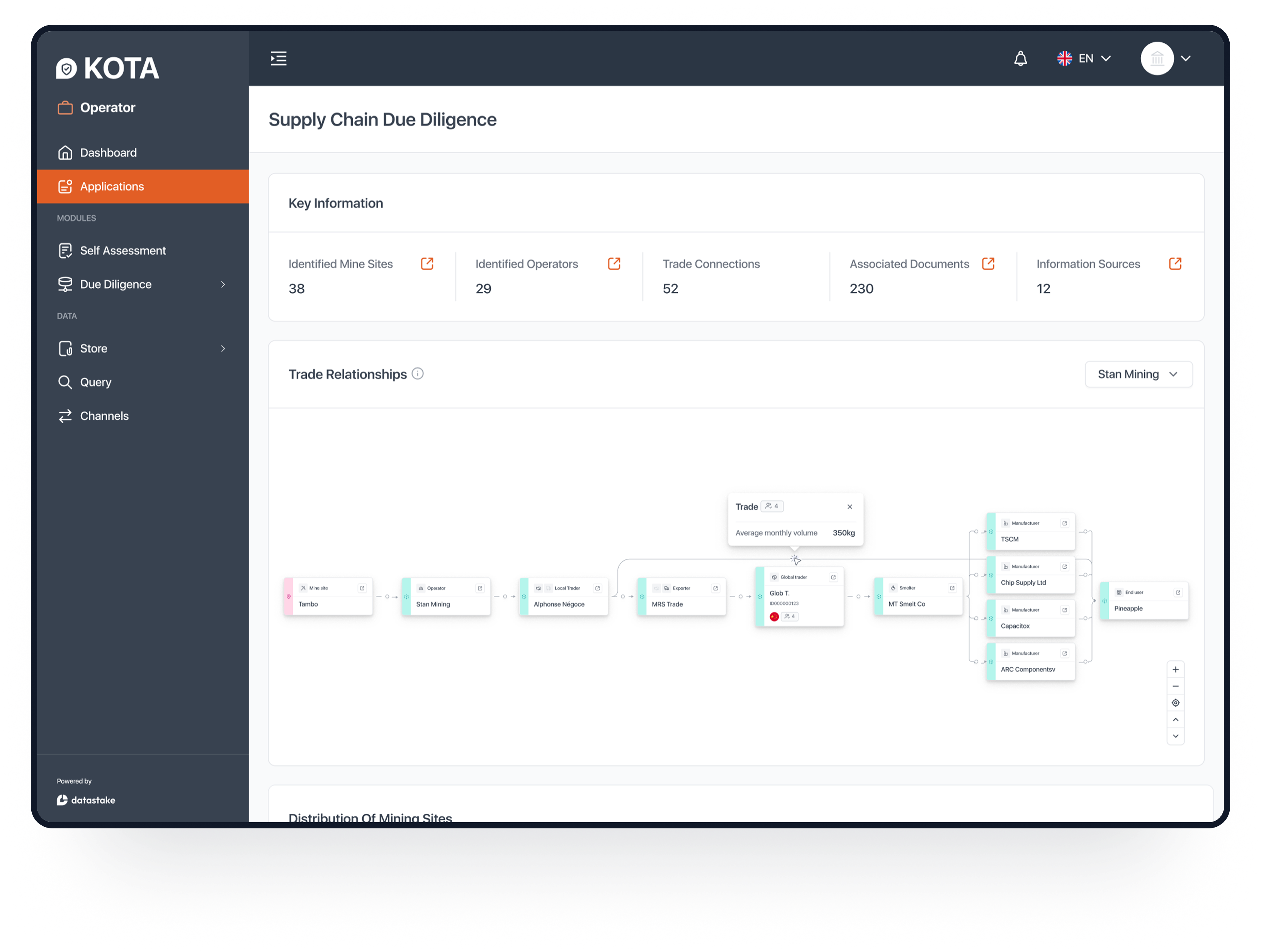
In the product
The operator surface.
Live today.
Start
Compile your profile. Engage your first bank.
Onboarding is free for operators. Your structured profile becomes the foundation for every counterparty you engage afterwards.